Wednesday, September 30, 2015

I Think My Teacher Hates Me and The Power of our Emotions


"I think my teacher hates me", the student said as he slid into the chair from across my desk and flopped the pass I had written for him onto my desk.  "Why do you think that?", I asked him.  "When I do good on quizzes she tells me I did a good job and it makes me feel very proud and good about myself.  But, sometimes, even when I do good, she gives me a look that makes me feel like I did not do well."  I am guessing that he had recently gotten that look prior to our discussion.

In his book Leaders Eat LastSimon Sinek spends Chapter 6 building the case that human beings are meant to work together, that when we work together we accomplish great things-greater than we would on our own, and that the chemicals Endorphin, Dopamine, Serotonin, Oxytocin work together to provide us a chemical incentive to work together.  Specifically he labels Serotonin and Oxytocin as the Social Drugs.  "Serotonin is the feeling of pride.  It is the feeling we get when we perceive that others like or respect us. It makes us feel strong and confident." (Leaders Eat Last, pg. 47)

While Serotonin creates feelings of pride in us for a job well done, like when we do well on a test, Oxytocin "is the feeling of friendship, love, or deep trust.  It is the feeling we get when we're in the company of our closest friends or trusted colleagues. It is the feeling we get when we do something nice for someone or someone does something nice for us.  It is responsible for all the warm fuzzies....Without Oxytocin we wouldn't be able to build strong bonds of trust and friendship."  (Leaders Eat Last, pg. 49)

Oxytocin is the social lubricant that not only helps us develop trust and friendship, but also pushes us to do things that will help cement those trusting relationships.  It is why the words of a teacher, or peer, have such power to both build us up, as well as unfortunately destroy us.  Sinek's favorite definition of love is "giving someone the power to destroy us and trusting they won't use it." Sometimes, unfortunately, without meaning we create the opposite emotion from what we want.

The Power of a Positive Act.  These are notes that we have created at Plymouth High School and the Weidner School of Inquiry @PHS that we have given staff members and students access to so that they can share positive thoughts with each other.  Each month we hold a class meeting for each grade level in which we recognize a student as student of the month. In order to be nominated for this honor, the student must be recognized by a teacher for making a positive contribution to the school. When they are nominated they receive a certificate recognizing this nomination via email.  Also at that meeting, teachers write and read positive notes that they then give to the students.  Finally, we recognize a teacher of the month, but even those teachers who do not win are winners.  The students write comments on why they believe the teacher they are voting for should be teacher of the month and those are then emailed to the teacher once we announce who has won.

All in all it has been an interesting journey as we work to create a more positive school environment, and put our natural chemistry to better use.  Each month we send out certificates, recognize students publicly, and crown a few prize winners, but the real winners of this exercise are not merely the students who are recognized publicly, or even those staff members who win.  The true winning comes in the lasting power of those notes.  The ability to read them, reflect on those moment, and find the strength to carry on in midst of the daily grind.

How do I know, every time I look in the back corner of my office, and see the collage of positive notes I have received over my career, and the hard parts of the day get a little easier, I am convinced again of the power of recognizing the good acts and achievements we see in others.


Things I Learned from Students this Week:
  • We should all love one another
  • We shouldn't judge each other
Things I Learned While Visiting Classes this Week:
  • Papules and postules are the medical names for zits. 
  • Glands that produce sebum oil (cause of acne) are located in the dermis
  • The symbol for again in Chinese started as a drawing of a fish, which they would have for lunch and then AGAIN for dinner.
Things I Learned from my Reading:
  • Wired tells the story of how trillions of clocks in our body keep time and the fascinating research around how they may be linked to cancer.
  • Also in Wired, you can learn how Jon Hauser makes $50 per hour playing arcade games. 
  • In Fast Company I learned about the Trinity wind turbine.  Which you can fold up and take in your backpack with you.
  • Lifehack highlighted 3 things that about school that Elon Musk would like students to copy.
  • The New York Times tells how the Lighting Science Group is making light bulbs that can help babies sleep better and teenagers pay better attention in class.
  • Finally, in the sad but true department, The Chicago Tribune writes about a group of parents who are on a hunger strike to get better schools for their children. 


Wednesday, September 23, 2015

Lessons Learned from Students this Week

This past Sunday our school suffered a tragedy when one of our students, David Bacon, committed suicide.  It has been a week of watching students and staff members hold each other close, hold each other up, and pull together to work their way through the many feelings a loss like this brings.

This week I learned how being together may not be able to prevent tragedies, but it definitely helps us to get through them.  I also learned that our students and staff are amazing, ok I already knew this, but I saw it in many different ways this week.  I was moved to tears as I walked the halls and saw students and staff picking each other up, supporting each other, and holding each other close as they tried to find a way through a terrible week.  One of the most impactful displays was this amazing letter from one of our students to our football coach:

Hey Mr. B... 
I know you're overwhelmed and going through a very difficult time. We all are. I don't know if David went out with a reason, or if things have been leading up to this. Nobody knows what goes through someone's head and nobody will truly understand how it feels until they've been there too. I truly am amazed how many other communities have come together to support us. They've put aside the fact that we're top in the state and kicking butt, were undefeated this year, and maybe just they're "enemies". Who knows. But they put everything aside to support our team and community and that's what restores my faith in our generation. Seeing the pain in the eyes of my family that's on the team, and people on the team that I know for a fact are very strong guys that I thought I'd never see cry absolutely tore my heart in a million pieces. Seeing the pain in every single person at PHS including myself kills me. I'm also amazed at how our school has come together and everyone is supporting everyone. I've been there. I've been where David was two nights ago. I know how it feels because I'm still fighting it. But to see our school and community come together like it has totally changed my outlook on Plymouth. I want you to know that everyone is here to support you and the team including his family. Nothing will ever be the same. Yesterday it literally felt like a huge piece was missing from our school and it truly was. I hated seeing everyone so hurt yesterday. I want you to know that no matter how long it takes you to be your happy, energetic, enthusiastic, and normal self again, we will all be waiting for the day to see you smile and hear your laugh again. It's definitely going to be a while before we can all smile and be happy again, but eventually life will keep going, and this will only make us more aware and stronger as a school and a community. I've learned to love PHS, and this topped it off. PHS has totally proved how much they care about each and every one of us. I can't wait to hear about the win this Friday because those boys are gonna win it for David. Each and every one of those boys out there have a heart like fire and I know first hand they will kick butt and win for David. They'll go far this season for David. They won't want other teams to go easy on them because they are strong and David wouldn't want them to be looked down upon. You treat those boys like you treat your kids. You're a family and family sticks together in times like this. I have faith in the team to be strong on Friday and I know right now in practice it's probably emotional and beyond difficult to stay strong without David ever coming back, but you'll all make it through. Rockies always do. Just remember we're all waiting on the day we get to see you smile again after this terrible tragedy. Good luck on Friday. It'll be tough, but the team will come out stronger than before. I've been sending prayers out to David's family, and I consider the whole team his family as well. We're all here for you and you're not alone. 
~Whitney 

These simple words from a student to her teacher, trying to find a way to get him to smile again, while knowing it will take a while.  Her eloquent words have done a much better job of summing up what I saw and learned this week, than I could ever hope this post would do.

Thursday, September 17, 2015

Hey You Forgot to Write this Week!

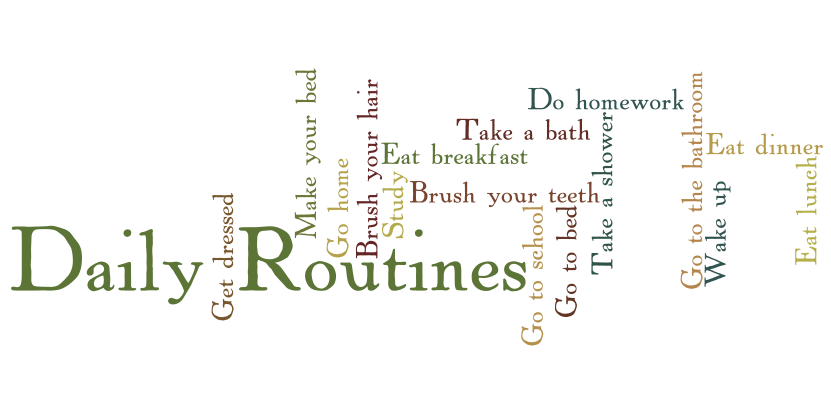
https://eslimaginarium.files.wordpress.com/2010/05/daily-routines.png


Hey, you forgot to write this week, Mr. Davis said to me as we spoke in night school.  Yea, I said, my whole week got knocked our of rhythm and it threw everything off, including my writing.  Funny thing routines, when they are working we barely notice them.  All our little rituals, quarks, and superstitions all work together to bring comfort to us, provide us with a sense of security, and bring a rhythm to our life.  But if one thing is off, even something minor like waking up five minutes late, or leaving something at home so that you have to circle the block to go back in, can through your whole day out of wack.  Even planned interruptions, like days off from school/work, can have an adverse effect on our psyche, and our learning.

It is not so much the disruption of the routine that puts our learning in a less than optimal state, it is the way it alters our day and pushes us into times, areas, locations, and methods that do not fit our optimal learning pattern or environment.  Each of us has them, things that we do to help us prepare to learn, places that we learn best, and methodologies that help us to maximize our learning.

For me my best learning occurs in the morning, usually in a coffee shop where I can focus on what I am doing, enjoy a nice pumpkin spice latte, and have just enough activity to take short breaks to people watch.  Additionally, I learn better by reading than watching videos or listening to podcasts.  That might be why my second favorite place to learn, is walking early in the morning with articles pre-loaded on my iPad and along the trails in Winona Lake before they are crowded with bike riders.

Interestingly, while I am very attuned to how, where, and under what style I learn best, I am embarrassed to say that I was not always sure how they learned best, nor was I sure that they knew either.  Sadder still, while wondering about these two questions, I did little to either learn for myself about my learners, and conversely teach them how to learn.  How much do you know about our learners?  More importantly, how much do you want to know?

Things I Learned from Asking Students What They Learned Last Week:
  • The lighter, in color, a crystal is the clearer it is.  Bismuth  is rainbow colored due to oxidation.
  • I learned how to create a 2D game on the computer in my independent study class.
  • 1 of our students is writing a book that is a crossover fan fiction combining Percy Jackson with Star Wars.
  • Explorer 1 has left the heliosphere
  • Denmark has 4 extra letters:  å æ é ø on their keyboard

Things I Learned While Visiting Classrooms:
  • MathXL has a feature called Virtual Nerd that explains how to do problems to students when they are stuck.  I sooooo wish that I had this when I was in HS math.
  • Tu' (the singular you in Spanish) is to be used in informal settings for example with people you know well.  While usted is to be used for you in more formal occasions.
Things I Learned from Reading (Due to it raining when I went walking on Saturday shortly after I started, these articles are actually from the week before-rhythms and routines again):
  • Elvis Presley once flew 2 hours to Denver, CO from Graceland to get a 8,000 calorie sandwich called the Fool's Gold that combines a hollowed out loaf of bread, an entire jar of peanut butter, an entire jar of jelly, and a pound of bacon.
  •  A new pool opened in a London high rise, that spans the two towers of the high rise and is made of glass so that swimmers can see people on the street below them. And people thought having a pool on the second story of a school was crazy.
  • Google Docs now has a voice option that allows students to speak to type from the tools menu in Docs.
  • From the Cybersecurity Division, be ware of ATM skimmers which look like a regular ATM slot, but are designed to steal your information when you go to get cash. Krebs on Security has the story.
  • Ed Week discusses research that perfectionism both helps and hurts students in the learning process and in life. 
  • This long and interesting article from Helen Rosner tells of the 127 Sale which runs for 1 weekend each year and is billed as the world's largest yard sale stretching from Alabama to Southern Michigan along US Route 127.
  • Finally, Edutopia evaluates 3 classroom tools to use for formative assessment.  My favorite-Kahoot.

Wednesday, September 2, 2015

Learning the Power of Social Media


It started with an email, continued on the phone, and then moved to social media, but ultimately it was a tale of communication.

Sometimes learning comes from experiences that we never believe are going to bring us new knowledge.  Monday I received an email at 3:05 AM (I did not actually see it until 5:30 AM) informing me that our data plan was about to go over, we were .5 GB under our limit.  I immediately texted my family at home and told them to not use any data.

This was a new experience for me, as we had previously had unlimited data. In July in an attempt to lower our bill I chose a plan with a limited supply of data and after reviewing our historical data us, I chose one that was basically double our average use for the past year to insure that I would not get emails like this.   The problem came when I looked online at our usage data. While it showed we were almost maxed out, when I added the individual totals we had used 1/2 our allotment.  This lead me to call Sprint Customer Service, to find out what was wrong.  The individual I spoke to was not able to tell me why there was a discrepancy, but that he would put in a ticket and get back to me with the results.

The next email I received told me that we were now over our limit, by .5 GB.  and then after school we were over by 1 GB.  I called Sprint, after seeing that my daughters usage had doubled in a few hours, with no notification as to what the earlier problem had been.  I quickly called Sprint and spoke to another customer service person, who said they would remove the overages from the bill and then was going to work with me to expand our plan to the next highest level, which was about $15 more at the time I considered my switch, but at $15 per GB over it was worth it.  Unfortunately, before I could finish this, I had to end the call, while I was on hold, to go into a meeting at the courthouse.

When I got home I received a 4th email saying that we were know 1.5 GB over and owed an additional $22.  I quickly called Sprint again, to find out how it was still going up when no-one was using data and to find out why it was spiking so suddenly today.  This is when my waiting and frustration began.

I was on hold for roughly 15 minutes and then when the call was answered, the person on the line could not explain to me what was happening, would not remove any charges, and when I asked about a new plan she said all I could sign up for was a plan that would triple my data limit, and cost $10 less than when I had unlimited data.  When I asked about the next highest plan that I had almost signe dup for, she said that plan was no longer available.  It was at this point that my frustration boiled over to anger and I asked to speak to her supervisor.  She said she would get him and I was put back on hold.  After 20-25 minutes she returned to say that she was looking for her supervisor still and asked me to wait.  After another roughly 30 minutes, at which point the thought crossed my mind that this was a delaying tactic to get me to merely hang up in the hope that I would not call back, she returned and said that she still could not find a supervisor and would I wait.  I responded that no I would not, that I wanted to speak to a supervisor now and that I was considering leaving Sprint.  She said she could not get the supervisor right then, but she would take my number and have him call me.

I gave her my number, and hung up on what was a 1 hour and 18 minute call, in which I spent the majority of time on hold.  Thank goodness for speakerphones.  After 20 minutes I still had not received a call from a supervisor.  At this point I got online and began looking at Verizon.  Then I remembered that the new Sprint CEO Marcelo Claure was very active on Twitter, so I took a shot that he might see a tweet, never expecting the response that I received.  At this point, I will let the tweets to the talking:


After mutually following Marci Carris, Sprint's Senior VP of Customer Management, and Googling her to make sure that this was a Sprint employee, I sent her my information.  Within 10 minutes I received a call from Timvre with Sprint who listened to my story with as much empathy as can be conveyed on the phone, took down my information, and said she would look into the data issue and get back to me.  She then gave me a direct number to her and told me her working hours and the days she worked.  While I was on the phone with Timvre, I received a call from another 800 number.  When I played the message, after being called twice, I found out it was another Sprint employee named George from their corporate office in Colorado. 

I called George and he again listened to my problem with empathy.  Looked into the data usage issue with me on the line, remarking how their must be something wrong because my daughter's phone was using huge chunks of data early in the morning when she would be at home and on wifi, and said that he would erase the overages on my bill and work towards getting me the plan I had asked for a month ago that was no longer available at close to my current price.  He also gave me a direct number and said he would call back when he had information.  This lead to this missing word tweet.

I then received a call back from George in which he said that he could double my current plan for $10 more a month.  I took this deal, and will remain with Sprint for the foreseeable future, as they were able to turn a negative into a positive.  The reality is, Timvre and George communicated so well that even without the deal, I was prepared to stop looking and stay with them for awhile.  The deal, which was all I had asked for earlier, ended all thoughts of leaving.

It was when I was able to relax and reflect that I was able to think of the all the learning this night had brought to me.

  1. You need to advocate for yourself and your issues, not simply say they are a big company and they won't care about my issue or help me.  Sometimes in school, or life, we believe that our problems are insurmountable, or that the teacher or administrator we are talking to is too busy to care with our minor issues, so we accept less than what we deserve because we are afraid to ask or that they might say no.  Even if they say no, you have not lost anything as you are still were you just were.
  2. Sometimes you need to keep going until you find the right person to help you.  Just because the first person that you talk to can't, or won't help you, that doesn't mean that you should just give up.  Maybe another teacher can explain what you need to learn a different way.  Don't stop at the first no, keep seeking the assistance you need. 
  3. People respond to social media, even if you think there is no way they will.  In this case the CEO helped me to solve a problem, but think of all the experts that the internet can connect us with.  How much knowledge or help in learning we might be able to access.  The list is endless, and the possibilities infinite. 
  4. Communication is more than simply listening and responding to someone, more than even how we respond.  While I am happy with the outcome of this situation, it all would have been avoided if the 1st customer service representative had emailed me back to let me know what the problem with the data was, prior to the company changing the totals on my daughter's account.  This made me feel as if they were cheating me.  It didn't help that the usage of my family, despite no major changes in where or how they were using their phones, had more than doubled since I switched plans.  This ambiguity, and the unclear way in which data was explained on the website, made me feel as if the game was rigged against me. That my good deal, was not really a good deal. I quickly began to distrust Sprint and their accounting.  An email response to me, telling me what they had found and why the data usage was so high, would have likely lead me to accept the explanation and move on. How often do we give students vague answers as to why a policy is the way it is, or a decision had been made about a grade, without truly hearing their concerns and addressing the simplest of requests-please explain to me and help me.
  5. Correcting the problem, even after angering the person, goes a long way towards repairing relationships and beginning to rebuild trust.  I am not a big customer, Sprint could have easily let me walk away from their company.  Even if I complained, it is not like I have thousands, or even 1 thousand, Twitter followers or Facebook friends.  They made this right not because they were going to lose money, or look bad on Twitter, but because they valued the relationship.
Things I learned by visiting classes this week:

  • You can make a hologram viewer from an old CD case.  This one you need to see, so go ask Mr. Scheiber to see it.  Then after he shows you the first model, look at the giant one his students crafted to use with a tablet computer.  The great part is not the device, but the excitement I got to see in Mr. Schieber and his students as they worked on it.
  • The robotic arm that takes socks off the sock form is called a stripper.
  • Extension lines are used with dimension lines on a drawing to show you how big the part is.  They also do not touch the part, to avoid confusion.
  • When you let students hold a jam session in the hallway, where they have to create music on the fly, you get some amazing sounds.
Things students told me they learned this week:

  • How to create a law...it's a long story.
  • The months in Spanish August is Agusto.
  • Learning about racism and reading articles about it.  I really like it because when I got to the US that affected me a lot and I have learned to stand up to it.
  • I learned that I am pretty good at math based on my PSAT/SAT work.
Things I read this week that impacted my learning:


Wednesday, August 26, 2015

What I Learned this Week 8/20-8/26


I ended last week's post with my struggle to tie a bow tie.  As the picture above shows, I was able to accomplish this task, but it took a great deal of struggle.  Struggle however is good.  That struggle lead to one of those incredible light bulb moments, the ones that I loved to see my students experience when I was in the classroom, and it came from such a minor change in my learning approach.

Initially I started my quest to tie a bow tie the way any tech savy 21st century educator would, I search Google "How to Tie a Bow Tie".  That lead me to the following video:


It was good, and seemed simple enough, but as I followed along, I never ended with a bow, I ended with, well a mess... I am not sure what the problem was, if it was the accent of the teacher, the angle at which the video was shot, or my own incompetence (most likely) in attempting to tie the tie.  One problem I had was that my only feedback came at the end, when the tie was in neither a bow, nor actually tied.

So, I did what any normal learner would do, I found another video:


This one was slightly better.  The angle seemed different, I liked the cheery disposition of the person tying the tie, but the biggest change came when you came to the step that requires you to create the second part of the bow by pushing it through a loop that you have created.  Fast forward to the :59 second mark of the video, and you can see the first step towards my light bulb moment.  At this point, the teacher folds the front part of the tie in half, and allows the learner to see the loop that has been created in the back to push the tie back through.  With this information, I now had a better idea of where my next step would go, but alas, this only resulted in me being able to create a knot, but not a bow.

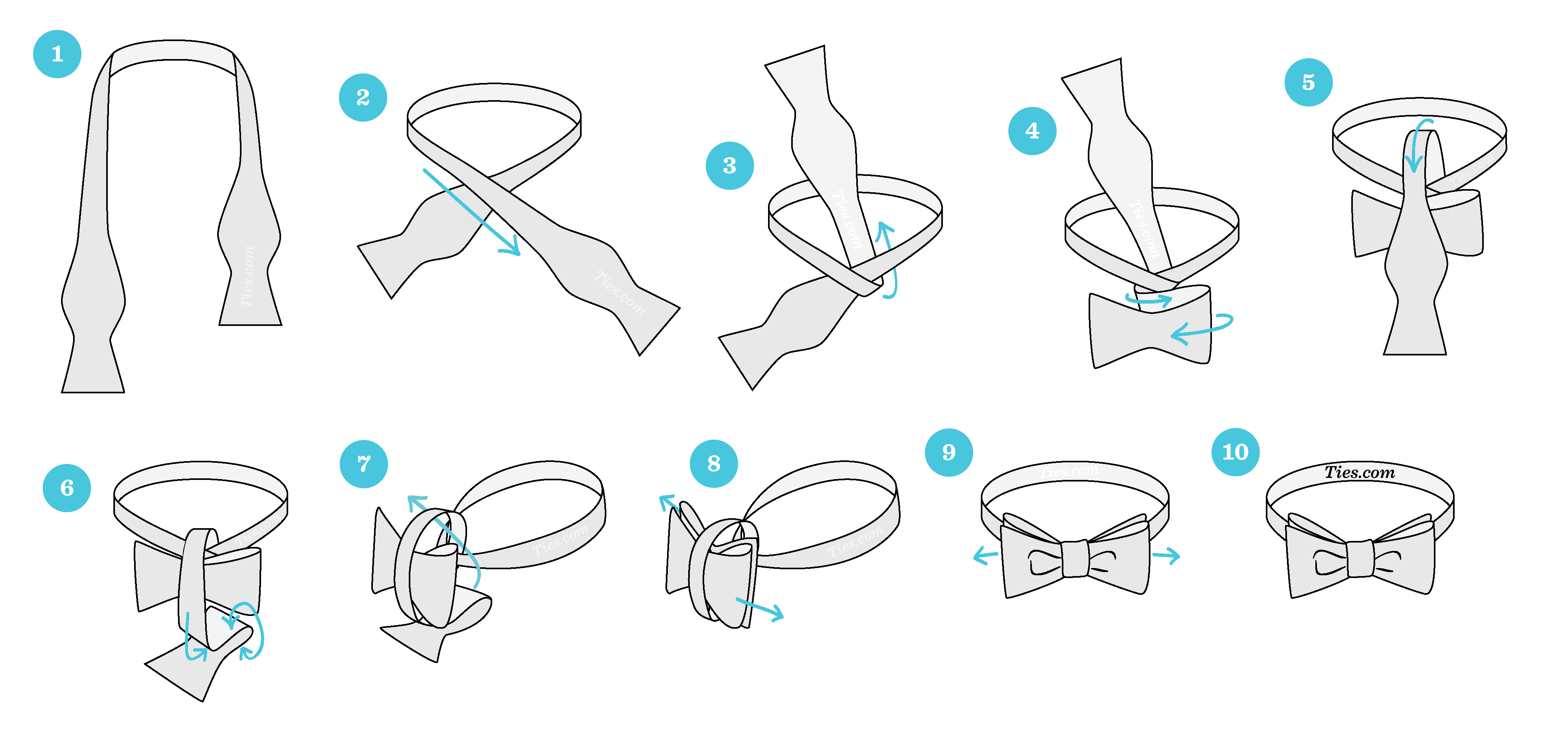
My third attempt, was better still.  I moved away from video, to a visual only approach. My first attempt was with a step by step drawing of how to tie a bow tie:

Taken from: http://www.ties.com/public/img/how-to-tie-a-tie/instructions/how_to_tie_the_bow_tie_knot_tying_instructions.png
This was better, because I could see each step as I went, but I still could not get the bow to appear.  I thought that maybe if I had words to go with the visual, then I would be able to figure out where I was going wrong.  So I turned to another image:

http://www.dispatch.com/content/graphics/2012/12/31/1-bow-ties-art-gkekts45-1bow-tie-graphic-eps.jpg
This was the best yet, as I could read along step by step.  With renewed gusto I attacked the problem at hand and proceeded to tie my bow tie...except I didn't.  I still could not quite get the movement in step 5 in the drawing right.  When I would fold the tie over and then up, I could not get the bow to correctly fold back through the loop, but at least I was on the right track.  Then looking very closely at the directions, and I saw in tiny print above the first step the following language:
Practice first by tying the bow tie on a leg. Once you get the idea, tie it around your neck
So I followed the directions more closely.  I sat down, stopped looking in the mirror, and tied it around my leg.  After the first attempt, the light bulb came on.  There were two things that I needed to do differently.  The first was to make sure that I was putting the folded end back through the loop (see step 6 above).  The second was to stop looking in the mirror when I got to that step, as the reverse image was causing me to put the end back through the front of the tie, and to not put the folded end in first.

As I prepared to again try to tie the bow tie around my neck, I wondered why the experts on the videos, did not give this simple tip to their viewers.  As I pondered this more, I realized that for them tying a bow tie was second nature, they had forgotten the early struggle and thought that by showing us how to tie the tie around their necks their viewers would simply get it.

I got up and in my first attempt, I was able to finally tie a bow tie, after only 1 hour.  I then realized that my brilliant plan to then slip it over my neck would not work, and I went to bed with trepidation that in the morning I would not be able to replicate my success and all my efforts would be for naught.

So what did I learn from my bow tie experience.  First and foremost I learned yet again that struggle is not bad and that figuring things our for yourself is a very rewarding experience.  That during the struggle the key was not only to not give up, but to analyze my mistakes and think reflect with each attempt what I could try differently, or what information I could find to add to my attempts.

At the same time, I also realized the importance of having someone that I could ask questions of and guide me.  My struggle would not have been nearly as long if I could have had a live expert beside me, giving me solid feedback so that I could more quickly learn from my mistakes and get to that moment of triumph.

It makes me wonder, as we attempt to educate our students on a daily basis in subjects that are new and foreign to them, how can we use our expert knowledge to give them a better picture of how they can succeed.  More importantly, when we give them assignments to work on by themselves, what little tips, like tying the bow tie on your leg first, might we forget because we know our subject too well?


Things I Learned in the Classroom:
  • Vernal=Spring.  I had always assumed this given the vernal equinox, but did not think about the fact that it does not mean spring, but rather of or connected to spring.
  • You can add up the energy within an ecosystems food pyramid (energy being derived from eating plants and animals below you in the pyramid ala Mufasa's explanation to Simba) to determine if the ecosystem can support those animals and plants.
  • Any 3D shape that is flattened (in geometry) is called a net.
Things I Learned Students are Learning:
  • I learned 2 step equations, for example 2G + 7G =15 would be solved by combining the like terms to get 9G=15 and then dividing both sides by 9 to solve for G.
  • You can use cold spoon to get rid of a hickie (not really sure if this worked based on the evidence on the students neck-ewwww)
  • I learned about scarcity (unlimited wants/needs but limited resources) from a county commissioner and that economics is the study of scarcity.
Things I Read that Impacted Me:

Lots of good reading items this week, some with direct application to the classroom, others just fun and quirky.  Let's start with helpful classroom tools.
  • As we head towards parent teacher conferences, I found this post by Richard Byrne on creating a choice eliminator for Google Forms to be helpful.  It shows you how to create a form that automatically eliminates a choice, for example a meeting time, when someone selects that choice.  I thought it would be a great help in setting up parent appointments via an email to those parents you most want to see, but can't seem to ever reach by phone.
  • Richard Byrne also provided a helpful list of 5 Tools Students Can Use to Keep Track of Assignments.  My personal favorite is Dayboard which I installed on my school computer.  Every time I open a new tab-think how many our students open daily-it shows me the top 5 tasks I need to accomplish that day.
  • The final Richard Byrne post was How to Quickly Create Vocabulary Lists from a Document.  I thought this would be useful for all teachers when they give students close reading assignments from the web as an added way to add some vocabulary work to the close reading work.
  • Of particular interest to me was this article from KQED's MindShift on whether it is better for students to take notes digitally or with pen and paper.  The results the article points to are certainly enlightening. 
  • Finally, two quirky articles.  The first from Fast Company on how the signage in cities are an architectural road map to past eras and history.  Be sure to watch the embedded video, it really adds to the article.  The second from the New York Times on Giga-Coasters.  These are roller coasters that have a drop between 300 and 399 feet.  The article is unique in the way it is formatted.  Make sure to watch the videos, as you can almost feel yourself going through the coaster.  Here is my favorite:


Wednesday, August 19, 2015

What I Learned this Week 8/13-8/19


Sometimes learning comes easily, sometimes it is much harder.  The larger question when I think about my learning this week is where does my comfort zone for learning lie, and how can I push myself to expand it.  Let me explain.  This week I started an Ed x course through The Smithsonian Institute titled The Rise of Superheroes and their Impact on Pop Culture.

The course offers students three options for their study of this topic.  The history track, the creative track, and the combination track. The choice of which option to pursue is up to the individual learner.  Within the history track students will study a historical era and the superheroes of that era with a final task of discussing how a particular superhero of the student's choice evolved from myth and through time.  Within the creative track, the student will create a new superhero and over the weeks develop a villain,  a setting, story, and finally design and illustrate a scene.  The combination track has the student do both assignments each week.

My difficulty came in choosing which track I would pursue.  If I chose the history track I would be working in an area that I was very comfortable with, using methods of inquiry and writing that I had done before.  If I chose the creative track, I would be exploring a side of myself that I  use, but not in the context that I would be asked to work.  Particularly the ability to draw characters.  Despite the fact that I could use a character generator, draw stick figures, or use images from the internet, I was very uneasy about pursuing this learning.  It was well outside my comfort zone, and it would push me academically in ways that I had not been before.
Ultimately, I chose to audit the history track and pursue the creative track, despite my nervousness about this type of study and stretch myself to learn new skills, despite my misgivings about my success because this is the type of learning I want my students to pursue as they go through not only school but life.

In the course of my studies this week I was able to learn that most superheros are based on ancient myths, that among my classmates Batman (my favorite) was their favorite superhero, that their favorite villain was the Joker (mine is Lex Luther), that if my classmates could have any super power it would be teleportation (mine would be the ability to fly because I am afraid of it and I don't).

For my first assignment I searched for Gods and Goddesses that focused on learning or wisdom as I wanted to design a character that would inspire others to learn and grow.  My research uncovered two gods and one goddess that I was intrigued by: Coeus a Greek wisdom god, Snotra a Norse wisdom goddess, and Thoth the Egyptian author of the Book of the Dead who is the god that is the master of time, mathematics, astronomy, reading, writing, and arithmetic.  The choice came down to the fact that this god had a picture, while the others did not.

Unfortunately, I did not learn what UCT time was until after I tried to turn in my superhero slide only to learn that 23:00 UTC (Coordinated Universal Time) which was 7:00 PM Eastern time. Thus, there seem to be even simpler lessons to be learned in the midst of my broader learning experience.

Things I learned visiting classes this week:

  1. Stages originally were set on a slope or hill that tilted downward towards the audience.  Thus the term moving downstage, related to going downhill or towards the audience.  Upstage referring to moving up the hill or away from the audience.
  2. You can use Google to convert currencies.  I realize this might seem obvious, but I had been using xe.com which was my primary source for this information when I taught Econ.
  3. Language acquisition takes 5-7 years in total.  Social language develops faster than academic language second and takes longer.
Things I learned from students this week:

  1. Junior year is hard.
  2. Psychology the whole Chapter 1
  3. Adhesive tape uses moisture to stick. 
  4. In English class we read a poem about the Native Americans and how they had their land stolen.
  5. We watched an inspiring story about an wrestler who had MS and lost every match, but persevered and finally won.
What I read this week that taught me something new:

  1. Converse gym shoes originally made entirely from rubber to keep the wearers feet dry and sand free on the beach.  The article From Converse to Kanye: See the Rise of Sneaker Culture from 1917 to Now in Fast Company gives a brief history of sneakers, including my daughters favorite-Chuck Taylors.
  2. Edutopia features classrooms designed by teachers on a budget in their article Tips for Creating Wow-Worthy Learning Spaces gives teachers 6 simple areas of design (flexibility, belonging, interaction, attention, neat, and concentration) to consider as they think of reworking their learning space including videos of teacher rooms. 
  3. Ed Bates, writing in SmartBlog on Education, gave out Classroom Management Tips and Tricks for the start of the school year.  His focus on establishing consistent procedures and expectations for students helps to create a classroom that encourages learners to learn.  
One last thing I learned, how to tie a bow tie, but you will have to wait until tomorrow morning to see that :). 

Wednesday, August 12, 2015

What I Learned this Week-August 5-12


Last Wednesday we began our transition at PHS to both a balanced calendar and from a 5 period a day trimester schedule to an 8 period day semester schedule.  The adjustment in everyone's equilibrium continues to be an ongoing learning process as staff members adjust to an entirely different pacing of classes, students adjust to more coursework due to the increased volume of classes, and I adjust to trying to figure out what period we are in on a daily basis, plus the shortened time between classes to visit classrooms and see students. All in all, it has been a smooth transition though.

As part of my thoughts on a new year, I wanted to step up to an article I had read earlier this summer in which educators were challenged to make their learning visible.  The article, which I have subsequently lost in my Pocket archive, made me really think about my role as an educator who has a passion for learning, and helping others to learn as well.
At roughly that same time, I happened upon my blog and realized that it had been nearly a year since I had written anything.  A year in which lots of learning occurred and the sharing of links happened on twitter, but the internal processes, and the growth I made from that reading stayed hidden and unshared with a wider audience.  Something that goes against my very core as a learner.

Finally, I put all of the ideas together while reading Edutech Musings Blog written by my twitter friend Chris Fancher formely of Manor New Tech in Texas, now an instructional coach at Decker Middle School in Manor.  Each week Chris has a post titled Things that Peaked my Interest this Week in which he lists some of his favorite readings and videos of the week.  I like reading this, and usually save 3-4 of the articles for me to read at a later time.  But it lacks an insight into what Chris is learning from these articles, and how he is growing.  Something that he does so well in his other posts.  

All of these sources made me I want to model a weekly post about what I was learning along the lines of what our Assistant Principal, Kyle Coffman, does with his weekly Friday Flash email that highlights comments from students as they answer his question: "Tell me something good" as well as information about literacy, a passion of his, and staff/student/school accomplishments.   Thus I hit upon What I Learned this Week Wednesday.  Each week it will be my goal to highlight things that I have learned while visiting classrooms, talking to students, and reading from a variety of sources.  This weeks list includes:

What I Learned in Class this Week:

  1. Ragtime was a pre-1900s music sensation.  As a history teacher I am somewhat embarrassed that I did not know this already.  
  2. Cadets at the United States Air Force Academy sleep on the floor so that their beds are always perfectly made in the morning, and thus they can save a few minutes for extra sleep.  
  3. If you give a teenager a card that says-Get the ingredients you need and make Rice Krispy snacks-what you end up with is nowhere as good as when you give them more detailed directions.
What I learned from Students this Week (all entries are quotes from students who were asked, "what did you learn this week"):
  1. I am really liking building trades we learned how to find the height of a building without going up it.
  2. I learned 127 medical terms, my favorite is rhinoplasty which is surgery to the nose.
  3. I learned trying to graduate early is kinda scary, but over the last 2 years I've learned when times are rough you just need to push through it.
  4. I learned about a new business in Plymouth-The Potters Pad where you can go paint your own pottery.
What I Read this Week that Taught me Something New (Truth disclosure, this first set are items from over the summer as well as this week):
  1. I learned that the simple nudge of a text message can help students learn more by reminding them to do their homework.  The article from KQED's MindShift titled "Can Text Messages and Interventions Nudge Students Through School" so inspired me that tomorrow we are meeting with the students who our guidance department has identified at most at risk to have them sign up for a Remind course so that our Director of Guidance and I can send nightly reminders for students to do their homework.
  2. On a related note, I learned their is a web based app called Whats Due that will automatically send students due date reminders to their iOS (Apple) and Android devices.
  3. Finally, from Fast Company, I learned that changing your reading habits can have health benefits.  The article titled "How Changing Your Reading Habits can Transform Your Health" showed how reading can change your perspective on life and gives you a renewed understanding of yourself.  This renewed understanding can help to make you more resilient in the face of challenges.  Additionally, reading for pleasure, can reduce stress, lower your chance of suffering from depression, and even help stave off dementia.  The ways to change your reading were to: Read what interests you, and not what you think you should read, Find 30 minutes a week to read, Create a challenge for yourself, and to Not stick with a book your not enjoying. 

Image from http://www.theworld4realz.com/wp-content/uploads/2014/03/lightbulb-moment-300x300.jpg

Sunday, August 3, 2014

Blended and Online Learning Class Reflection on Motivation


This week we finished our studies by listening to Dan Pink discuss his findings on motivation.  In his July 2009 Oxford, England TedTalk, Pink rebuts the idea that if...then... motivational strategies work best.  Citing research like the Candle Problem, Pink shows that if...then... motivational strategies in which workers are rewarded by getting more pay, or other incentives, while effective in repetitive tasks do not work for the complex tasks of the 21st century.  With this in mind we, were asked to reflect on how we might incorporate autonomy, mastery, and purpose into our professional situation.

Last year, I attempted to use some rewards to try and get students to class on time.  When students had an excessive amount of tardies (over 12 in a 12 week period) they were assigned a week of lunch detention.  After seeing this not be a deterrent for a majority of our students who were habitually late, John Fishback (one of our guidance counselors) suggested that we try something beyond punishment as a motivator.  With that in mind, I began offering students in this situation, and for tardies beyond 12, the following incentive.  For everyday that you are on time for all of your classes, the next day's lunch detention will be removed.  For many students this worked, they stopped being tardy, for a week, to avoid the lunch detentions, but then they would be back in for getting to 15 tardies.  At 15 tardies, they received a week of lunch detentions, plus two 1 hour after school detentions.  Again they could remove the lunch detentions for being on time daily, and for every 2 consecutive days without tardies the after school detentions would also be removed.  Again for a majority of the students this worked, for a week, but there were still some students who got to 18 tardies, which lead to 1 week of lunch detention, 2 after school detentions, and 1 2 hour after school detention to be served on a Wednesday, between the after school detentions on Tuesday and Thursdays.

The incentives at this level were the same, but in order to remove the 2 hour detention, students needed to be on time for every class for 5 consecutive days.  Again, this worked for the majority of students, but there were still 2-3 who progressed to ever longer periods of lunch detention, after school detentions, and 2 hour detentions.  This example shows that for a routine problem, getting to school on time, the carrot and stick approach would work.

Much like Pink shows though, for tougher motivational problems, like improving grades, students need more than a carrot and stick approach.  For these kinds of problems students need more than just being paid, although Steven Levitt in this blog post shows that when faced with the potential loss of money students will do better on tests, they need something that will engage them in what is to be learned.  This is a much harder system to design, on the surface, than simply paying learners to do well on a test.  But, it is not as hard as it seems to be.

The keys to getting students, and workers, motivated for these higher end tasks according to Pink are autonomy, mastery, and purpose.  With these tools, students become engaged in what they are doing. To get our students to do more, we simply need to find ways to give them autonomy and purpose in what they are doing.  When I taught at Bremen, this occurred in 1 trimester when I taught US History B by theme as opposed to by chronology.  The students looked at American history for the 20th century and created decided on the themes we would study.  A majority of what we studied within each of these themes was presented by students in a manner that they chose.  The students were motivated, grades improved, and the presentations were incredible.  I could not wait to for that class to arrive each day, and I think the feeling was mutual based on conversations we had.

At the E3 Technology Conference this past week at Warsaw High School, Angela Maiers termed this Unleashing Genius, while Kevin Honeycutt would regularly go to students he was teaching with a unique problem or software he wanted the class to use.  He would ask them to do him a favor and learn the software, then present it to the students.  The student would learn the software, present it to the class, and in an added bonus have an opportunity to shine in front of their peers.

It works for adults to, Kevin got me to spend 2.5 hours creating the Youtube Video below, after a 30 second conversation about a method I use to monitor my daughters' social media posting.  The conversation, after a session on parenting and social media, went something like this:

Me:  Kevin, have you heard of If This Then That.
Kevin:  No.
Me:  You can use it to set up recipes to email you when your children post pictures to Instagram
Kevin:  That sounds great, I had heard a little about it but don't know much.  Can you do me a favor, can you make a video on that and send it to me via twitter.
Conference ends, I go home, have dinner with my family, spend 2.5 hours producing this over too many takes.


This year, I am focusing on how I can unleash the genius of my students and peers.  I am asking at least 3 students each day, and 1 staff member, what their genius is.  I am then asking them how they are sharing that genius with the world.  All it is really going to take, is to find ways for them to utilize that genius within their classwork.

Tuesday, July 29, 2014

Liberating Genius: A Day with Angela Maiers


I spent yesterday at the e3Tech Conference at Warsaw High School.  In reality, due to the keynote and sessions that I chose to attend, I got to spend my day with Angela Maiers.  It was a great way to re-invigorate myself and get fired up for the coming school year, which I was really needing.  In a weird twist, after having a great year last year and being excited about our senior mentor program, freshman homeroom program, and STAT revisions that we have been working on this summer, I was very down about my job.

When I took the job at PHS the greatest disappointment was that they changed my title from Assistant Principal to Dean of Students.  It may not feel like a major change, but mentally this made me feel pigeon holed into being merely the discipline guy.  I believe that I did this job well, but I longed for more outside of the area of discipline and attendance.  This year, with the creation of our freshman homeroom program, senior mentor programs, and re-calibration of our STAT program, but in many ways I still feel that restriction as being "the discipline guy".  In fact, when most people hear what my job is they instantly say, "oh so your the guy that deals with all the bad kids", or something to that extent.  In my mind, I think they are picturing this guy:


Mrs. Maiers opened the day by asking me what my genius was as I was standing in the hallway waiting for her to get done talking to a friend of mine.  In my typical, "I suck" manner I told her that I really had none, for which I was gently scolded by her.  Great start to the day...

During her keynote presentation she asked everyone in the audience to be courageous and take a selfie, then tweet it out by stating what our genius was.  Being the lemming that I am at heart, I turned, and snapped a selfie:


As the day went on and into the night when I was at home, I though of more to add.  Thus, this is my genius (for the moment):


  • Sharing my passion for learning
  • Thinking creatively
  • Connecting with at risk students
  • Caring for others
  • Using technology


Hopefully this list will as I continue to grow as an educator.  Ideally, at the end of this year it will include an entry that says "Helping others to Liberate their Own Genius" so that I can do for the students I interact with what Angela Maiers did to me; make me see and believe that I am more than just the Dean of Students, help them to see that they too are geniuses and that they need to share their genius with the world.

Please comment below, so I can learn what your genius may be.

Reflections on a Growth Mindset Part III-The Music of Growth

This summer I attempted to go back to running.  I set a goal of running at least 1 mile per day from the day after graduation until school resumed in August.  I made it 32 days in a row, but have not run now in nearly 3 weeks.  The idea that we form habits by doing something for at least 28 days is true, and my running had become a habit, but the habit of not doing something is also very powerful and often hard to overcome because it is soooo much easier than doing something.  For example, last night I had intended to start running again, get a new streak going, but it was too cold to run.  Yep, it was 70 degrees in Indiana in July and I was too cold to run, I wonder what will happen when it is -10 in February and I have to get into my street parked car to drive to work?  I am not sure if this inertia is the result of a fixed or growth mindset, but what I do know is that this inertia keeps me from experiencing my daily dose of growth mindset via Miley Cyrus, Eminem, Kristin Chenoweth, and Idina Menzel.

As I ran more, I started creating playlists of music, searching for songs to keep me going.  The three best songs in those runs became The Climb by Miley Cyrus, Lose Yourself by Eminem, and Defying Gravity sung by Kristin Chenoweth and Idina Menzel in Wicked.


I tried to time the songs to my runs, so they would come out at the times when I most needed to be inspired to dig deep and keep going.  Inevitably they always would, because each song speaks to that biological desire we all have to learn, grow, and become better versions of ourselves.

Ultimately this matters because the more we can expose our students to a growth mindset, in ways that they can connect to and internalize, the sooner they will begin to embed that mindset into their own lives.  And that is when we will be able to see their growth begin to take off.

Monday, July 7, 2014

Blended and Online Learning Class-Module 3 Reflection

This week's reflection is centered around the Florida Center for Instructional Technology's Technology Integration Matrix and I focused my study of the available resources on my former area of teaching, Social Studies.

The matrix is a very valuable took, in that it allows teachers to explore lessons that integrate technology at a variety of levels.  These levels are:  Entry-the teacher begins to use technology tools to deliver curriculum to students, Adoption-the teacher directs students in the conventional and procedural use of technology tools, Adaptation-the teacher facilitates students in exploring and independently using technology tools, Infusion-the teacher provides the learning context and the students choose the technology tools to achieve the outcome, Transformation-the teacher encourages the innovative use of technology tools, technology tools are used to facilitate higher order learning activities that may have not been possible without the use of technology.

In addition to describing levels of technology integration, the matrix is also segmented on the vertical access by different types of learning environments.  The environments are:  Active, Collaborative, Constructive, Authentic, and Goal Directed.  This segmentation furthers the usefulness of the tool so that teachers can tailor the ideas from the tool to the learning environment that the students will be working in.

Based on my teaching practice from when I was in the classroom I believe that I would be at the collaborative adaptation or collaborative infusion level depending on the lesson.  I was a fairly early adopter of technology in my school district and worked hard to integrate it into the classroom in unique ways, but I do not believe I ever reached the transformative stage where students were driving the use of technology, except for maybe in the creation of a class blog and podcasts maintained by the students, which never really worked the way I envisioned.

If I were still in the classroom, I believe that I could get to the transformative level by the end of the 1st grading period this coming year, however, I would  want my learning environment to change from being a collaborative one to being an collaborative/authentic one as I would want to implement PBL within my classroom the majority of the time.

In order to make that growth happen I would need to restructure my lessons so that they are PBL based, provide learner development in the PBL process for students early on, and utilize BYOD (Bring Your Own Device) to create a 1:1 technology environment in the classroom so that students can easily and fully integrate tech into the daily flow of class.  Along with this, my class would go 100% digital through the use of the Canvas learning management system..  Additionally, as tools are rolled out with projects via Canvas I would need to provide learner development lessons in the use of that technology.  For these I would want to create student lead lessons given by students who had already mastered that technology and allow for students to suggest tools to use for each upcoming project.

Sunday, July 6, 2014

Reflections on a Growth Mindset, Part II-Growth is Hard Work

"I have not failed. I've just found 10,000 ways that won't work.”-Thomas A. Edison

As always, I am a little behind in setting my thoughts to computer screen, and thus what should have been my culminating post for the week becomes the second of what will now be a four part reflection on a growth mindset and grit.  The first piece in the series focused on Pursuing a Growth Mindset, and was more a response to an article by Alfie Kohn from the New York Times on May 24, 2014 entitled Do Our Kids Get Off Too Easily.  This time I am reflecting on David Brooks New York Times piece from June 16, 2014 entitled Learning Is No Easy Task and is based on a blog post by Scott H Young in a on growth.

In his article, Brooks describes a series of growth paradigms.  He begins by noting that growth is not linear, as we often think it is, but rather comes in a variety of forms that rately proceed from point A to B in a structured consistent manner.  One of the challenges in education, for eternity, has been balancing this non-linear growth with the linear outline of courses...Today we are going to study the Civil War, next week will be Westward Expansion, and in two weeks we will be looking at the Second Industrial Period in US History...even if Johnny and Suzie are still stuck with why the North couldn't just let the South leave and avoid all the blood shed after the unit ends.  Our linear path, does not often leave us with a model that embraces the different structures that Brooks describes in his article.

The first structure that Brooks describes is that of logarithmic learning, and this is the type that I want to focus on the most.  This is the learning that takes place when we take up a new sport or activity, like running.  Brooks, citing Young, notes that in the initial stages you make a lot of progress quickly, but then as you grow in the activity, your growth slows down and the breakthroughs become fewer and further between each other.  Those initial runs, while hard, lead very quickly to improvements in endurance and technique and to large drops in time when you race.

This spring when I began running again, my first 5K I was only able to run 2 miles of it, and that by running the first mile, walking the second mile, and then running to the finish where there were spectators again (yes vanity is a motivating factor), and it took over 45 minutes.  My next run, less than a month later and after I had only been running for 10 days and had yet to go over 1.5 miles at a time, I was able to run 2.5 miles of the race by running the first 1.5 miles, then walking .5, and running the final mile again.  My time also dropped to just below 40 minutes.  That is very strong growth in a short period of time.  As I progress, and keep adding distance each week, I feel myself getting stronger, but my ability to drop time is likely to be a lot less pronounced and eventually I will plateau somewhere around a 27-30 minute 5K.  Still, great growth from where I started, but in order to drop further below, I will need to change my training more, vary my run distances and focus on technique much more than I do now, and then to only get small amounts of growth.

Much like when I coached swimming and our new swimmers would drop time nearly every meet, and drop a lot of it, while our experienced swimmers would need to focus for weeks on end on very tiny adjustments to drop a few tenths of a second, the discipline to keep at it when the task becomes harder requires a different mind set from those first weeks when results come easier.

Brooks then goes on to describe exponential growth, where you need to put in Malcoom Gladwell's 10,000 hours before you can truly master the skill.  Learning paths that resemble a staircase where you grow a little and then have a period of stagnation followed by another period of growth.  Learning that acts like waves lapping at the beach, they come in and leave a little residue of knowledge, then recede, then return, to leave more and solidify what came before.  Finally, he describes the valley shaped learning curve, where you have to go down before you can rise up.  He likens this to the immigrant experience in America, but for many of our students, immigrant or not, this is the path that they often take when coming to school, and it is in the depths of those valleys, when support is not offered that we often lose them for good.

Brooks concludes by noting that "Thinking about growth structures reminds you that really successful people often have the ability to completely flip their mental dispositions" and that "the crucial thing is not what traits you intrinsically possess.  The crucial questions are: What is the structure of your domain?  Where are you now on the progress curve?  How are you interacting with the structures of the field?"

In describing these differing growth structures and asking these final questions, Brooks speaks of the nature of having a growth mindset, of being able to recognize that in our students growth occurs in different ways, at different times, and along different paths.  As educators, we need to not only recognize that this occurs in our learners not merely from the start of their school lives, but within each year and within each course.  We also need to plan for the varying types of growth and shape the path of learning to best support our learners where ever they may be on that path.  For logarithmic growth we need to make sure that they have the discipline to continue to work hard in those initial euphoric stages when the learning comes easy, and then the growth mindset to continue to persevere when the learning becomes slower as the skills needed to improve become harder to master.  In many ways, it is through this shaping of the path that we might best help our students.  By giving them confidence in their ability to learn early in the process we will be able to give them encouragement to continue on.  By creating a growth mindset in them, and supporting their efforts, when the tasks become daunting we can supply them with the fortitude to master deeper levels of learning and make those minor adjustments in their learning process to find significant breakthroughs.  The ability of us as educators to cultivate in our students the type of grit and mindset that allows for not 10,000 failures, but rather 10,000 insights into what might work, may be the most important innovation we can make as a profession.


Monday, June 30, 2014

Pursuing a Growth Mindset


In the past few weeks I have been reading a lot about Grit and having an Growth Mindset.  In my online class on Blended and Online Learning last week was devoted to thinking about having a growth mindset, I am currently reading Mindsets in the Classroom by Mary Cay Ricci, and in the last two weeks I have read thought provoking pieces in the New York Times by David Brooks and Alfie Kohn on the topic.  

In addition to doing this reading I have gone back to running this summer with the goal of running at least 1 mile per day until school starts again on August 13.  So far I have made it 23 days straight, and have had a lot of time to ponder my views on this topic.  Over the the coming week I am hoping to explore these thoughts more deeply on this page.  The first topic of my post will be a response to Mr. Kohn's article, which began this cycle of thought for me nearly two weeks ago.

In the May 3rd edition of the New York Times, Mr. Kohn wrote an article entitled Do Our Kids Get Off Too Easy? In this article, Mr. Kohn attacks the culture of Grit that he has seen developing within both conservative and liberal groups in America.  Early in the piece, Kohn states:


But seriously, has any child who received a trinket after losing a contest walked away believing that he (or his team) won — or that achievement doesn’t matter? Giving trophies to all the kids is a well-meaning and mostly innocuous attempt to appreciate everyone’s effort.
Even so, I’m not really making a case for doing so, since it distracts us from rethinking competition itself and the belief that people can succeed only if others fail. 
Rather, my intent is to probe the underlying cluster of mostly undefended beliefs about what life is like (awful), what teaches resilience (experiences with failure), what motivates people to excel (rewards) and what produces excellence (competition).   

Mr. Kohn then backs up his belief that creating competitive environments does not help improve outcomes for students by stating that, 
In any case, no one ever explains the mechanism by which the silence of a long drive home without a trophy is supposed to teach resilience. Nor are we told whether there’s any support for this theory of inoculation by immersion. Have social scientists shown that those who are spared, say, the rigors of dodge ball (which turns children into human targets) or class rank (which pits students against one another) will wind up unprepared for adulthood?
Not that I can find. In fact, studies of those who attended the sort of nontraditional schools that afford an unusual amount of autonomy and nurturing suggest that the great majority seemed capable of navigating the transition to traditional colleges and workplaces.
He then makes a compelling case that what we should seek for our students and children is what he refers to as "unconditionality", or the idea that children know that they are loved not because of what they achieve, but rather for who they are.  It is here that I have become confused about Mr. Kohn's views on this topic.  It appears that he is embracing the idea of building within students a growth mindset, but without the student having to put forth any effort in attempting to achieve their goals.

I believe part of this view comes from Mr. Kohn's interpretation of the intentions of those advocating for students to develop Grit.  Mr. Kohn, as outlined in his article, believes that those advocating for students to develop Grit have a very Hobbesian view of the world.  He states:
Rather, my intent is to probe the underlying cluster of mostly undefended beliefs about what life is like (awful), what teaches resilience (experiences with failure), what motivates people to excel (rewards) and what produces excellence (competition).Most of all, it’s assumed that the best way to get children ready for the miserable “real world” that awaits them is to make sure they have plenty of miserable experiences while they’re young. Conversely, if they’re spared any unhappiness, they’ll be ill-prepared.
 I do not believe that those who advocate for the development of Grit believe that the world is a very dark place, but I do believe that they realize that students need to experience work hard to develop their skills and improve.  This hard work, often comes with struggle and failure, and how we respond to these setbacks ultimately determine if we succeed or not.  I can have an immeasurable amount of self confidence born from knowing that my parents love and support me, that I have the skills to succeed, but what happens the first time that I face hardship, or fall short.  Without having a strong belief in my abilities, born from succeeding when the milestone was not easy, will I be able to push through the self doubt that comes with failure, or will I crumble and fail to meet that challenge before me.


Much like Michael Jordan, I do not believe that we are born with natural abilities that will carry us to our goals because we have them, but rather we need to refine these abilities through hard work and perseverance.  

While I struggle with participation trophies, and realize that even though the players got an award they still know they lost (much like when we have young athletes play the game but do not keep score so that the idea of competition is eliminated), I also understand Mr. Kohn's desire to lessen the influence of competition within our schools.  When we pick winners and losers by having students compete within the classroom we move into the realm of a fixed rather than growth mindset.  This does not mean that students should not face struggle and have to work hard to achieve the learning put before them.

When I am in the midst of my goal of running at least 1 mile daily, and it is late at night and I don't want to run because it has been a long day, will my confidence in my ability to run a mile get me off the couch and out into the heat and the darkness of a nighttime run?  Or will the Grit that I have developed that makes me want to succeed push me out the door, into the heat and darkness, not only to get in the minimum mile, but to go further than I thought I could when I started the run?  If we eliminate anything, it should not be the struggle, but rather that we evaluate each student based not on an arbitrary set of outcomes set for all, but rather by looking at where they began their studies, and where they finish.  Much like I runners who run in old age not against the pack, but against their own times and for their own goals.